
A Chevy Corvette Stingray and a McLaren GTS both can top 200 mph. But unless you have access to a track, you’re paying a hefty premium — including for gas — just to poke along with everyone else. And good luck finding room for everything when making a Costco run.
The Internet of Things (IoT) is like that. The need for speed often is outweighed by practical considerations such as device cost and battery life. That’s why RedCap was created: Capability overkill can kill a business case. Introduced in 3GPP Release 17, RedCap’s “reduced capability” version of 5G New Radio (NR) is designed specifically for IoT applications that don’t need anywhere near 5G’s peak speeds of 20 Gbps.
If that sounds like a niche market, it’s not. Some analyst firms forecast the global 5G RedCap module market having a compound annual growth rate of roughly 25% through 2033, when it will be worth $210 billion.
Why? Smart cities, smart grids, smart buildings, Industry 4.0, and numerous other verticals have applications where longevity is a top criterion. 5G provides that kind of future proofing simply because it’s a newer technology than 4G.
But 5G RedCap goes a step further. It’s designed to optimize battery life so devices can remain in service for a decade or even longer. An example is extended discontinuous reception (eDRX), where the device puts itself to sleep to save power. That type of future proofing is critical for large-scale deployments, where replacing devices or batteries in tens of thousands of smart meters every few years would be cost prohibitive for a utility.
And as a deployment scales up, so does the pressure to keep device costs down. RedCap meets that requirement by eliminating the complexity associated with gigabit speeds. (More about that in a moment.) If that sounds familiar, it’s because LTE Cat 1-4 used the same approach. In fact, RedCap sometimes is described as a bridge between 4G and 5G because it supports many of the same applications requirements as LTE Cat 1-4, such as sub-100 Mbps throughput.
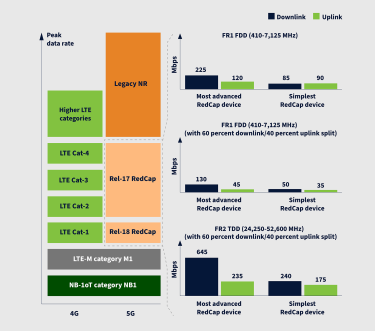
Enhanced RedCap (eRedCap) debuted with 3GPP Release 18. It reduces throughput to 10 Mbps on both the downlink and uplink, further reducing bill-of-materials (BoM) costs and power consumption. The lower BoM is another reason for the bullish outlook because it expands both the addressable market and the profit margin for device OEMs, such as fitness wearable brands.
Operator support also is important — and growing. For example, in June 2024, AT&T began upgrading its standalone (SA) 5G network to support RedCap, while T-Mobile began selling RedCap devices in October 2024. Both Redcap and eRedCap also can be deployed as private networks, such as in the Citizens Broadband Radio Service (CBRS) band.
“RedCap has now been commercially launched by 14 service providers across multiple global markets,” Ericsson says in its June 2026 Mobility Report, citing GSA research. “Furthermore, 42 service providers in 27 countries are currently investing in 5G RedCap technology.”
The Antenna Angle
Although modules get a lot of attention when discussing RedCap/eRedCap, it’s important not to overlook the role of antennas, which directly affect device cost, market potential, profit margin, battery life, performance, and reliability.
For example, one way that RedCap/eRedCap keeps BoM costs low is by using fewer antennas: two for Redcap and one for eRedCap compared to four with full 5G. That’s because RedCap supports only one transmit antenna rather than uplink MIMO. RedCap supports downlink MIMO, but it’s mandatory only for FR2 spectrum.
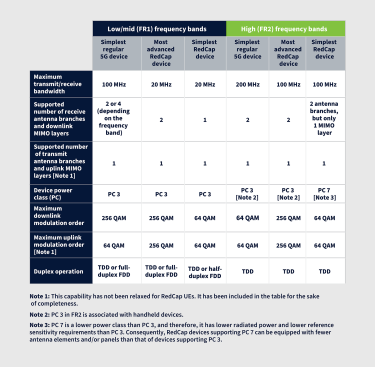
This also enables device OEMs and systems integrators to leverage their LTE product designs and experience when selecting and integrating antennas for RedCap/eRedCap. Their spectrum allocations are nearly identical to LTE’s except for the additional frequency bands above 2.7 GHz that only 5G uses.
Another important design aspect is operator efficiency requirements. For lower bands (617-894 MHz) in the U.S., antenna efficiency should be greater than 32% and greater than 50% for mid and high bands. Operators provide total radiated power (TRP) and total isotropic sensitivity (TIS) figures, such as this example from AT&T. (For more information about TRP and TIS, see “Why Cellular Pre-Certification is Critical.”)

As RedCap and eRedCap adoption accelerates, antenna selection will play a critical role in achieving the cost, power efficiency, performance, and certification requirements that make these technologies so compelling. Whether you’re developing smart meters, asset trackers, industrial sensors, wearables, or other next-generation IoT devices, partnering with an experienced antenna provider early in the design process can help reduce risk and speed time to market. Taoglas offers a comprehensive portfolio of high-performance cellular antennas, along with design, testing, and certification expertise to help ensure your RedCap deployment succeeds. Contact the Taoglas team to discuss your application and find the right antenna solution for your device.


