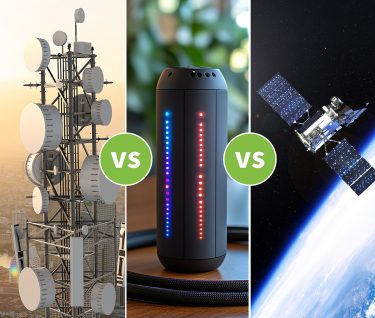
Cellular, Wi-Fi, and satellite each have advantages and disadvantages for IoT applications. Read on to learn how they compare and when to consider combining them to meet an application’s requirements.
Cellular
Cellular has nearly ubiquitous coverage in cities and suburbs because they have the population density that mobile operators need to justify building infrastructure. That makes cellular a solid choice for IoT applications in populated areas.
After that, the choice of which cellular technology comes down to application requirements such as throughput, latency, power consumption, and device costs. 5G was the first cellular generation designed to meet IoT’s unique and myriad requirements because the traditional consumer and business application markets were saturated, and operators saw IoT as key for opening new revenue streams.
For example, 5G supports peak speeds of up to 20 Gbps, which is 20 times faster than LTE-A, with latencies as low as 1 millisecond versus 30-70 msec for 4G. That makes 5G a viable option for bandwidth-intensive and latency-sensitive applications, such as edge computing, that wouldn’t be possible with 4G and otherwise might have used copper or fiber. (For more information, see “4G vs. LTE vs. 5G: How Mobile Technology is Evolving.”)
Many IoT applications are low bandwidth and/or use battery-powered endpoints. 5G RedCap caters to both. Named for being a “reduced capability” version of 5G, RedCap is designed for sub-100 Mbps applications. RedCap also maximizes battery life with mechanisms such as discontinuous reception (DRX), where the device puts itself to sleep to save power. That’s ideal for IoT devices that need to remain in service for several years. (For more information, see “With 5G RedCap, Less is More for IoT.”)
5G made its commercial debut in 2019, so it’s had over six years to build out coverage on par with 4G and ride down the cost curve. IoT applications are notoriously price sensitive, especially with mass-scale deployments such as tens or hundreds of thousands of sensors and controllers around a smart city or refinery.
Cellular uses licensed spectrum, which eliminates the congestion problems that plague Wi-Fi. But mobile operators aren’t the only type of business that can use cellular bands. For decades, many utility companies owned and operated cellular networks exclusively for their applications, such as meter reading.
More recently, “private” 4G/5G expanded that option to other types of businesses, such as logistics parks. So when choosing a wireless technology, device OEMs and systems integrators should look at whether their target customers and verticals are using private cellular. (For more insights, see “Private Cellular: A Crash Course into Deciding Why, How, Where, and Which Technology” and “Private 5G: Top Customer Verticals and Why Wideband Antennas are Key for Serving Them.”)
NTN
Rural and remote areas have much smaller pools of potential customers, making it financially difficult for mobile operators to build cellular networks that provide the same level of coverage as in cities and suburbs. Non-Terrestrial Networks (NTNs) have emerged as an alternative to cellular for IoT applications in agriculture, oil/gas, and mining.
NTNs use low Earth (LEO), medium Earth (MEO), and geostationary orbiting (GEO) satellite constellations such as Amazon/Kuiper, OneWeb, Skylo, and SpaceX/Starlink to provide two-way connectivity, whereas GNSS is used for positioning, navigation, and timing (PNT). Two-way satellite services aren’t new, but today’s NTNs dramatically lower the cost to the point that it’s viable for more applications than ever.

Smartphones such as the iPhone 14 have supported NTN since 2022, and by 2030, nearly half of all makes and models will. One reason is because 3GPP Releases 17-19 are adding capabilities while lowering the cost of implementing NTN. This trend benefits IoT because it can leverage many of the SoCs and other components used for NTN in smartphones.
When assessing NTN as a connectivity option, look at how each constellation’s speed and latency align with the application’s requirements. These vary widely, from tens to hundreds of Mbps and millisecond latencies between single and three digits. (For more implementation insights and tips, including how to choose the right NTN antenna, see “Fertile Ground: Non-Terrestrial Networks for Agriculture.”)
Wi-Fi
Wi-Fi is a widely used technology, which is both an advantage and disadvantage for IoT. Most large businesses own a WLAN, so using it for their IoT applications essentially is free, unlike public cellular and NTN. But those IoT applications also will be competing with the customer’s existing users for bandwidth and priority. The WLAN also may be designed to cover only offices and common areas rather than all of the other locations where IoT devices will be installed.
Wi-Fi has a limited range compared to cellular — including mmWave 5G — and it uses relatively high spectrum that limits the signal’s ability to penetrate walls and other obstructions. These are two additional factors that affect reliability and performance, as well as the choice of antenna. (For a deeper dive, see “Selecting the Right Wi-Fi® Antenna for Industrial Applications: A Comprehensive Guide” and “Reducing Network Downtime: Using Wi-Fi® Antennas and RJ45 Connectors in Harsh Industrial Environments.”)
Wi-Fi 7® is the latest generation and a good fit for bandwidth-intensive applications such as backhauling HD surveillance cameras. It’s twice as fast as Wi-Fi 6/6E because it supports Multi-Link Operation (MLO), which enables Wi-Fi 7 devices to aggregate 2.4 GHz and 5 GHz channels to maximize throughput. Another reason is that Wi-Fi 7 uses a higher order of Multi-User Multiple Input Multiple Output (MU-MIMO) antenna technology, which enables its access points and user devices to support twice as many simultaneous streams: up to 16×16 versus 8×8 for Wi-Fi 6/6E. (For more insights, see “Navigating Wi-Fi 7® Certification for Device OEMs.”)
Hybrid
Cellular, NTN, and Wi-Fi each have their unique advantages and disadvantages. That’s why it often makes sense to combine two or all three to meet all of an application’s requirements for coverage, performance, cost, and more.
For example, using NTN and cellular is a good fit for devices that will be installed in or travel through places where cellular coverage is weak or nonexistent. An example is a telematics solution that needs to maintain constant connectivity with a truckload or shipping container of high-value cargo. If there’s no cellular coverage on the remote highway or rural rail siding, the telematics device can use an NTN to send an alert that a door has been breached or that a geofence excursion has occurred.
Adding NTN support to a cellular IoT device doesn’t necessarily require an additional transceiver and another antenna. Many LEO and 5G bands are close enough that a single antenna can cover both. That’s why modules that support both cellular and satellite have a single RF connector for the antenna. (For more information, see “Combining Satellite and Cellular to Unlock New Business Opportunities” and “The Sky is the Limit: Combining Cellular, GNSS, and NTN for Seamless Global Connectivity, Positioning, and More.”)
In other cases, Wi-Fi can serve as a fallback to cellular or vice-versa. For example, a law enforcement vehicle could use cellular as its primary connection on the road but then switch to Wi-Fi at the station to upload video. (For another example, see “Autonomous Truck Specialist Leverages 4G/5G, GNSS, and Wi-Fi to Maximize Productivity and Safety.”)


