The migration from GSM-R to the Future Railway Mobile Communications System (FRMCS) is a quarter-century technological leap, from 2G straight to 5G. That makes it an ideal time for rolling-stock engineers, rail systems integrators, and the RF engineers who support them to fundamentally rethink their wireless strategies — not only for internal communications but also positioning, navigation, and timing (PNT) applications, passenger broadband, B2B services, and more.
In Europe, GSM-R starts approaching the end of the line in 2030. For engineers, one challenge is future proofing. When GSM-R launched, no one could have predicted how cellular technology would evolve over the decades. There’s no crystal ball for the next 25 years, either.
That challenge highlights the importance of choosing the right antenna — and early in the design process rather than three, six or nine months in. The right antenna provides longevity both in terms of future proofing and durability, which directly affects the module and all of the services that use it. Read on to learn how and what to focus on when comparing antennas to achieve a rail-grade system for the long haul.
Flexibility and Future Proofing
Most GSM-R systems use a narrow swath of spectrum between 876 and 925 MHz. FRMCS uses that spectrum but adds 1900-1910 MHz. So at a minimum, the antenna needs to support both of those bands.
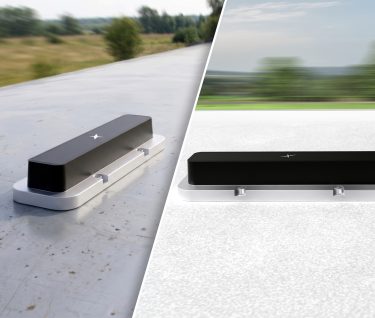
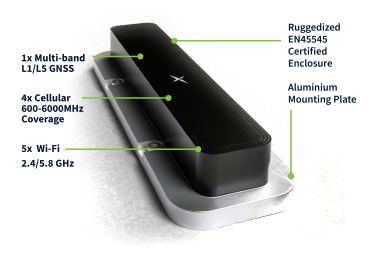
The ideal antenna goes far beyond that bare minimum to provide the flexibility to support any additional FRMCS bands in the future, as well as non-FRMCS applications — all within the same housing rather than requiring additional antennas. For example, the Taoglas MA8020 Raptor X series covers 600 MHz through 6 GHz, which means it supports:
- Every 4G LTE band and every 5G allocation up to the mid-band spectrum range. This means the antenna can support additional types of applications that don’t or can’t use FRMCS bands, including bandwidth-intensive applications such as cellular backhaul for onboard CCTV and video monitoring systems. This breadth also frees railways to switch mobile operators to take advantage of better coverage or better tariffs for non-FRMCS applications.
- Wi‑Fi® at 2.4 and 5 GHz. This provides the flexibility to use Wi-Fi for onboard services such as passenger broadband. It can also support operational applications such as intermodal container connectivity, where containers communicate over Wi-Fi with an onboard hub that then backhauls status updates and alerts over 5G. This approach can reduce the need for each container to maintain its own direct cellular connection, opening the door to more cost-efficient tracking services for shippers
- GNSS signals at L1 (1575.42 MHz) and L5 (1176.45 MHz). This enables support for PNT applications such as time-stamping the location of rolling stock and cargo such as intermodal containers as they’re moving or stationary. It also eliminates the expense of purchasing and installing a separate antenna just for GNSS.
Rail-Grade Durability
The more bands and technologies that an antenna supports, the more important durability becomes. If the antenna housing is easily damaged, vulnerable to water ingress, or both, those weaknesses jeopardize all of the services that rely on it.
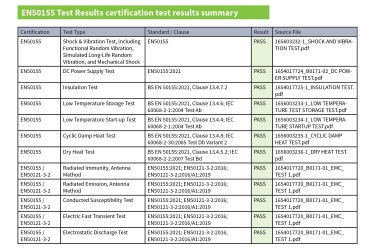
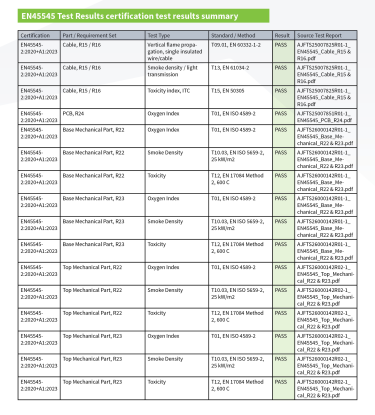
When comparing antennas, two key datasheet specs to look for are EN 50155 and EN 45545-2 compliance. A true rail-grade antenna has been independently tested to verify that it meets those specs’ requirements for environmental durability, vibration and shock, EMC, electrical safety, temperature and humidity exposure, and fire performance of key materials and components. For example, here’s the full certification rundown on the Taoglas MA8020 datasheet.
When reviewing datasheets, look for five additional specs:
- Water Ingress Protection. A rating of IP69K is ideal. To learn why, see “How IP and IK Ratings Measure Real-World Durability.”
- Impact Resistance. IK10 is the highest rating and indicates that the housing can withstand a 10 kg object dropped from 40 cm, such as softball-size hail.
- Storage Temperature. -40°C to + 85°C
- Operating Temperature. -40°C to + 85°C
- Non-Condensing Humidity. 65°C/95% RH


The Taoglas MA8020 also shows why less often is more. At just 59 mm tall with the mounting plate, the MA8020 keeps the kind of svelte profile that minimizes the risk of damage from low tunnel ceilings and other obstructions.
The bottom line is that when it comes to FMRCS, antennas aren’t just another component. Instead, they play a critical, fundamental role in the performance and reliability of the mission-critical and value-added services running over it. And as the longevity of GSM-R shows, antenna choices can affect business models and opportunities for decades.


