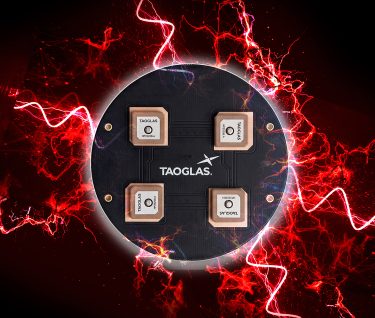
For a GNSS anti-jamming antenna, creating a deep null is only part of the challenge.
A Controlled Reception Pattern Antenna, or CRPA, uses multiple antenna elements and adaptive processing to suppress interference arriving from specific directions. This spatial filtering is particularly effective against in-band interference, where conventional RF filtering alone cannot easily separate the jammer from legitimate GNSS signals.
But there is another consideration: positioning accuracy.
As a CRPA adapts to the interference environment, the complex weights applied to its antenna elements change. These changes can also affect the composite phase response seen by legitimate satellite signals. For high-precision GNSS, that matters.
Why Phase Stability Matters
GNSS positioning depends not only on receiving a satellite signal, but also on preserving the information contained within it. This is particularly important for carrier-phase techniques such as RTK and PPP, where very small phase changes can translate into positioning errors.
At GPS L1, the carrier wavelength is approximately 190 mm. A change in electrical path length of just 1 mm corresponds to about 1.9° of carrier phase.
For a CRPA, three areas therefore need to work together:
- Antenna phase behaviour
- RF-channel matching
- Adaptive array processing
Stable antenna elements are important, but they are only one part of the system.
More Than Just the Antenna Element
Each element in a CRPA has its own amplitude and phase response. Once installed in an array, that response is influenced by the surrounding structure, including the ground plane, neighbouring elements and enclosure. This is known as the embedded element pattern.
The RF path behind each antenna matters too. Filters, LNAs, PCB transmission lines and connectors can introduce channel-to-channel phase and group-delay differences.
Finally, the CRPA processor combines these signals using adaptive complex weights. When an interferer appears or moves, those weights change to steer the null. Unless the complete system is appropriately designed and characterised, these changes can alter the effective phase response presented to the GNSS receiver.
In simple terms, the CRPA may successfully reduce the jammer while introducing a small apparent change in the satellite signal path. For conventional positioning, the effect may be relatively small. For precision carrier-phase GNSS, millimetres matter.
PCO and PCV
Phase Centre Offset, PCO
The offset between the antenna’s mean electrical phase centre and a defined mechanical reference point.
Phase Centre Variation, PCV
The change in carrier-phase response with satellite direction.
Both vary with frequency, and PCV can also vary with elevation and azimuth. These effects are well established in high-precision GNSS, where antenna phase-centre calibration is used to improve measurement accuracy. With a CRPA, another dimension is added: the effective response of the antenna system may also change as the adaptive weights change.
What Influences CRPA Phase Stability?
- Ground-plane geometry influences currents, diffraction and element patterns.
- Mutual coupling between antenna elements can change amplitude and phase response.
- Element positioning and manufacturing tolerances can create differences between nominally identical channels.
- RF-channel mismatch can introduce differential phase and group delay.
- Multiband operation means L1, L2 and L5 may exhibit different behaviour.
- Radomes and enclosures can modify the antenna’s electrical response.
- Nearby electronics and structures can disturb the RF environment.
This is why the antenna, PCB, RF front end and processing should be considered as a complete system, rather than as independent components.
Designing the Array as a System
Good CRPA performance is not simply about achieving the deepest possible null. The objective is to provide strong interference rejection while maintaining a predictable response to the wanted GNSS satellite signals.
Array geometry + embedded patterns + RF-channel matching + calibration + adaptive processing
Ground-plane size is part of that optimisation, but bigger does not automatically mean better. Different PCB sizes can affect element spacing, mutual coupling, embedded patterns and phase behaviour. The optimum solution should therefore be determined from measured array-level performance rather than PCB dimensions alone.
This is particularly relevant when comparing compact and larger CRPA implementations, where mechanical size, GNSS performance and interference resilience all need to be balanced.
Measuring Phase Stability
Traditional antenna measurements such as return loss, efficiency and gain remain important, but they do not tell the complete phase-stability story.
The complex radiation response, including both amplitude and phase, can be measured across angle and frequency in a controlled antenna measurement environment. For a CRPA, measuring the embedded pattern of each element helps capture the effects of the complete array.
The RF channels should also be characterised for relative phase, amplitude balance, group delay and frequency-dependent variations. Together, these measurements help engineers understand and, where necessary, calibrate the behaviour of the complete CRPA system.
The Goal: Preserve the GNSS Measurement
CRPA technology can provide a powerful defence against GNSS interference, but null depth alone does not define system performance. For applications requiring high positioning accuracy, the system must also preserve the integrity of the legitimate satellite signals.
That requires stable antennas, predictable embedded patterns, matched RF channels, effective calibration and phase-aware adaptive processing.
When those elements work together, a CRPA can do more than maintain GNSS availability in an interference environment. It can help maintain the measurement quality required for accurate positioning and timing.
The goal is not simply to null the jammer. It is to null the jammer while preserving the GNSS measurement.


