As wireless technology evolves, so the do the communications options for police, fire, and other first responder agencies in the U.S. Here are the top trends and technologies and what to consider when choosing and integrating antennas to take advantage of them.
FirstNet Coverage Expansion and 5G Upgrade
The FirstNet network launched nationwide in March 2018 using 4G LTE in Band 14. The first public 5G networks debuted over the next 12 months, but 4G was still a solid choice for first responder applications. That’s because as a mature technology, LTE had time to ride down the cost curve and develop a broad, deep selection of devices.
Today, 5G is a mature technology — and likely to remain the dominant one in terms of coverage, price points, and device selection well into the next decade because 6G probably won’t debut until 2030 at the earliest. That makes 5G the natural choice for agencies looking to upgrade to a technology that offers both higher performance than 4G and longevity.
In 2024, the First Responder Network Authority and its partner, AT&T, began an $8 billion, 10-year upgrade to 5G. The first major milestone was in April 2026, with the launch of 1,000 5G cell sites, all using the same Band 14 as their LTE predecessors. These new sites are nationwide, but with a focus on ensuring coverage in certain locations.
“More than two-thirds [are] in rural and tribal areas,” the FirstNet Authority says. “In addition, the vast majority enhance coverage for key public safety locations like fire stations, police departments, courthouses and hospitals.”
It’s important to note that the new FirstNet 5G sites are backward compatible with 4G. FirstNet will continue to support 4G for at least the next decade, which gives agencies the flexibility to do a phased upgrade to 5G. That’s a major plus, considering that perpetually tight municipal, state, and tribal budgets make it difficult for most agencies to replace everything at once.
Mobile Cell Sites Extend Coverage and Add Capacity
FirstNet and public cellular networks have one thing in common: They don’t always have the capacity necessary to shoulder additional voice, data, and video traffic in certain locations during major events such as the Super Bowl, the World Series, and concert festivals.
Portable cell sites provide that additional short-term capacity, as well as extend coverage to any areas that the permanent FirstNet and public sites don’t reach well or at all. They’re also used when some or all of the permanent FirstNet and public cell sites are out of service, such as after a natural disaster.
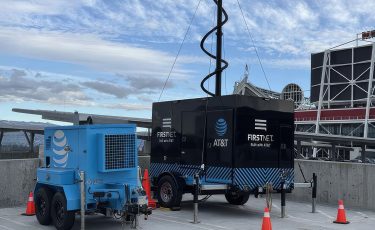
Photo Credit: FirstNet powers connectivity for public safety at the Big Game
These temporary sites are typically mounted on trailers and referred to as COWs, short for “cell on wheels.” FirstNet has its own herd of COWs, including Satellite Cells on Light Trucks (SatCOLTs), Response Communications Vehicles (RCVs), and Compact Rapid Deployables (CRDs). The latest addition is LEO Cell Trailers (LCTs), which use Low Earth Orbit satellites for backhaul when the permanent microwave, copper, or fiber backhaul is either unavailable or incapable of handling the additional traffic.
A New Option for Mission-Critical Push to Talk
Land Mobile Radio (LMR) technology has been around for nearly a century. One reason for its enduring popularity among first responder agencies is its support for Push to Talk (PTT), especially after the Nextel network was shut down in 2013.
FirstNet offers two mission-critical PTT (MC-PTT) services that provide a user experience comparable to LMR PTT but with additional benefits and capabilities:
- Push-to-Talk provides LMR-style PTT but on the FirstNet network in the Band 14 spectrum dedicated exclusively to public safety agencies.
- Rapid Response adds capabilities such as streaming video and the ability to prioritize emergency calls over other FirstNet users.
For a deeper dive into both types:
- Listen to the FirstNet “Episode 91: At Its Core: Mission Critical Push-to-Talk” podcast.
- Read the “FirstNet Rapid Response” white paper.
How to Choose a Public-Safety-Grade Antenna
Most public safety vehicles need an antenna system capable of supporting not only FirstNet, but also public 4G and 5G networks, LMR, GNSS, and Wi-Fi. Typically the best option is an all-in-one design because it’s easier, faster, and thus cheaper to install than multiple antennas. And in the case of police cruisers, an all-in-one antenna also means only one hole to plug when it’s decommissioned for public sale.
Taoglas offers several all-in-one antenna products, each with multiple versions to meet customer requirements for bands, enclosure colors and form factors, IP ratings, cables, connectors, and more:
- Synergy, SynergyX, and SynergyXR antennas have low-profile, screw-mount enclosures about the size of a hockey puck and are available in up to 11-in-1 configurations.
- Raptor X and Raptor Max antennas are available in a variety of enclosures, including shark fins, and up to 16-in-1 configurations.
- GuardianX antennas are available in up to 17-in-1 configurations and are designed for mounting on a vehicle’s side when a roof or trunk installation isn’t viable.
- Comet antennas have low-profile, puck-style enclosures and are available in up to 4-in-1 configurations.
- Pantheon antennas have low-profile dome enclosures and are available in up to 5-in-1 configurations.
- Colosseum antennas have low-profile enclosures about the size of a hockey puck and are available in up to 5-in-1 configurations.
- Olympian antennas have low-profile, screw-mount enclosures and are available in up to 3-in-1 configurations.
- Patriot antennas are available in up to 18-in-1 configurations, with a whip antenna for LMR. They’re designed to fit between the roof ribs on the Ford Interceptor, the most widely used police vehicle in the U.S.
- Storm antennas have the lowest profile (31 mm) in the Taoglas public safety portfolio and are available in up to 5-in-1 configurations.
For a deep dive into choosing and implementing a multi-technology, multi-band antenna system, see:
- “Building the Emergency Services Fleet for the Future”
- “Fairfax County Police Hide Their Antennas in Plain Sight”
- “A Clear Choice for Public Safety”
- “Enabling Reliable, Redundant Communications for the Ultimate Mission-Critical Application: Public Safety”
- “Understanding FirstNet Certifications and Why Antennas Play a Critical Role in Mission-Critical Communications.”


