
5G was the first mobile generation designed to meet IoT’s unique performance, power, and price requirements. Feature sets such as Enhanced Mobile Broadband (eMBB), Massive Machine-type Communications (mMTC), and Ultra-Reliable, Low Latency Communications (URLLC) enable 5G to support IoT use cases that weren’t practical or even possible with 4G. Those are major reasons why 5G is steadily displacing copper, Wi-Fi, and other technologies in verticals such as smart factories.
Release 19 continues that focus with a host of enhancements to existing features, as well as a major new capability, all of which affect antenna count, band support, and link-budget assumptions. Read on to learn about the top Release 19 changes and capabilities that IoT hardware engineers should consider when developing their device roadmaps in 2027 and beyond.
Why the Future isn’t Now
When 3GPP finalizes a release, chipsets don’t hit the market the next day. Silicon vendors typically take several months to announce their next-gen products, with volume manufacturing beginning a quarter or two after that. Module vendors usually have access to samples so they can start developing their products, but they can’t ramp up production until their silicon providers have.
Mobile operators also need time to upgrade their infrastructure if the new release requires loading new software or hardware changes. The bigger the upgrade, the longer it takes, which means another year or more could pass before a new device has any — let alone many — networks to run on. This limits the new device’s addressable market to early adopters.
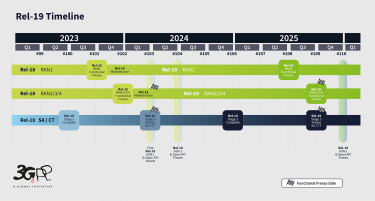
3GPP released the fully implementable Release 19 specs in December 2025. In March 2026, Qualcomm announced the X105, which it said was the world’s first Release 19-ready modem-RF system. At that point, samples were available to customers, with commercial products expected in the second half of 2026.
Thus one key takeaway for IoT hardware engineers is that it’s important to monitor silicon and module vendors for press releases and blog posts regarding Release 19. Their roadmaps are helpful for determining when it makes business sense for IoT device specialists to add Release 19 to their roadmaps.
Silicon and module vendor press releases and blog posts also can provide insights into operator roadmaps, such as participation in trials. For example, Qualcomm’s March 2026 release says, “Global operators are showing support including China Telecom, China Mobile, China Unicom, Deutsche Telecom, KDDI, Telstra, T-Mobile, and NTT DOCOMO.” The GSMA’s website is another resource to monitor because it often has press releases about trials, such as a January 2026 demo by Keysight Technologies and Samsung Electronics covering use cases such as satellite-to-satellite mobility for seamless handovers.
Plan by Maturity
| Feature | Specification Status | What to Check before Designing It in |
| NTN Phase 3 | Complete in Release 19 | Chipset roadmaps, supported NTN bands, network and operator availability, certification path |
| RedCap/eRedCap | eRedCap in Release 18; further improvements in Release 19 | Module availability and the operator’s RedCap support on 5G standalone. |
| Ambient IoT | Specification published (TS 38.191) | Whether any commercial silicon and network support exists yet. |
NTN
5G initially added support for non-terrestrial networks (NTNs) in Release 17. Release 19 provides a third set of NTN capabilities, which 3GPP groups into five categories.
Terrestrial Networks (NTN) for NR Phase 3 improves downlink coverage, uplink capacity, multicast/broadcast support, and regenerative payload operation, and adds RedCap device support through targeted physical layer (PHY), and more general RAN updates, including architectural aspects.
Satellite Access Phase 3 provides new capabilities to support IoT and broadband services via NTN, such as:
- Store-and-forward communication for intermittent connectivity
- Direct UE-to-UE communication via satellite
- GNSS-independent operation and enhanced positioning
- System-wide aspects are specified for system architecture, application enablers, protocols, security, and charging
Enhanced requirements and test methodology for NR NTN and IoT NTN enables high-power UEs in FR1-NTN through new RF requirements and by supporting sub-5 MHz (down to 3 MHz) channel bandwidths via updates to system parameters, UE/SAN RF, RRM, and performance requirements.
NTN for IoT Phase 3 (for LTE) introduces store-and-forward satellite operation with regenerative eNB payloads, uplink capacity enhancements, and NB-IoT public warning broadcast support.
IoT NTN TDD mode introduces a TDD mode for NB-IoT NTN that enables half-duplex operation in satellite systems, extending NB-IoT NTN beyond legacy FDD operation to support additional NGSO Satellite deployments using Mobile-Satellite Service (MSS) spectrum.
Release 19 also has several NTN-related spectrum additions:
- Ku bands for NR NTN
- Additional operating NR bands for High Altitude Platform Stations (HAPS)
- Another NR NTN S-band: MSS band 2000-2020 MHz UL and 2180-2200 MHz DL
New NR NTN bands to support extended L-band and combined MSS L-band and extended L-band ranges - Another IoT-NTN S-band: MSS band 2000-2020 MHz UL and 2180-2200 MHz DL
- An LTE band for 5G broadcast for region 3 utilizing a geosynchronous satellite (defines a new standalone downlink-only LTE band for 5G Broadcast over geosynchronous satellites in ITU’s Region3, specifying corresponding UE and satellite access node RF requirements for 10MHz PMCH operation based on E-UTRA NTN)
For IoT hardware engineers, one important takeaway is that Release 19 requires the cellular antenna to support even more NTN spectrum. Present each as an implication, and mark the ones in the verify box: Release 17 defined L-band and S-band NTN bands (commonly cited as n255 and n256). Check current band edges.
Another important takeaway is the impact on link margins. 3GPP’s NTN studies assume a handheld device with low antenna gain (about 0 dBi) and linear polarization talking to a circularly polarized satellite beam, which implies about 3 dB of polarization mismatch. Antenna efficiency in the NTN bands therefore goes straight into the link budget.
GNSS
Release 17 NTN devices use GNSS for position and time data to pre-compensate timing and frequency. Release 19 adds GNSS-independent operation, which reduces that dependency, but GNSS and NTN transmit bands still sit close to each other: The L-band uplink is roughly 17 MHz above the top of the GNSS band. For IoT hardware engineers, that means coexistence should remain on the design checklist when developing Release 19 devices.
Other noteworthy GNSS additions include:
- On-demand broadcast of GNSS assistance data to enable on-demand broadcasting of RTK GNSS assistance data, with the LMF triggering specific posSIB broadcasts
- The BeiDou B2b Signal in A-GNSS for LTE and NR in both E-UTRA and NR systems to increase the positioning accuracy
- A-GNSS support for Navigation with Indian Constellation (NavIC) L1 Standard Positioning Service (SPS) in NR and LTE to improve positioning speed, sensitivity, and UE power efficiency
eRedCap
RedCap debuted in Release 17, followed by eRedCap in Release 18. As noted earlier, Release 19 adds NTN support for RedCap devices. For non-satellite IoT, Release 19 adds:
- NAS layer overhead reduction for data transfer using Control Plane Cellular IoT. This introduces the EMM TRANSPORT NAS message, replacing the legacy CONTROL PLANE SERVICE REQUEST to reduce NAS overhead while preserving existing Stage 2 procedures and functionality.
- Management Aspects of RedCap features. This extends the Network Resource Model and Performance Measurements to control RedCap UE access, support multi-initial BWP operation in coexistence scenarios, and enable RedCap-specific performance monitoring.
Antenna implications. One receive branch means no receive diversity, so each antenna’s efficiency matters more. A 5 MHz carrier does not reduce the bands the antenna must cover. Peak rate is capped at about 10 Mbps, bandwidth is 5 MHz in FR1, there is a single receive branch, and half-duplex FDD is supported. It targets the large installed base of LTE Cat-1 and Cat-1bis devices.
Ambient IoT
Ambient Power-Enabled IoT (AIoT) is the lone brand-new feature in Release 19. It introduces support for extremely low-power, backscatter-based passive IoT devices with a simplified PHY/MAC interface for indoor inventory and command use cases. Instead of batteries, AIoT devices use harvested ambient energy from sources such as radio waves, light, motion, and heat.
3GPP says AIoT is designed for isolated private network deployments (e.g., SNPN). Release 19 provides a controlled way to identify AIoT devices, discover them in a given area, and exchange application data with them despite their intermittent, energy-constrained operation. On the RAN side, Release 19 provides the framework for integrating these devices into the 5G system architecture.
In AIoT devices, the antenna is both the energy harvester and the modulator. For IoT hardware engineers, this creates important considerations such as matching to a non-linear rectifier at very low input power, the size-versus-efficiency trade-off at the extreme end, and orientation sensitivity.
How to Get Started
3GPP’s work on Release 19 is complete. For IoT device specialists, Release 19 work is just beginning. There’s a lot to consider, which is why Taoglas is ready now to guide you through key aspects such as the antenna selection for RedCap and NTN designs.


