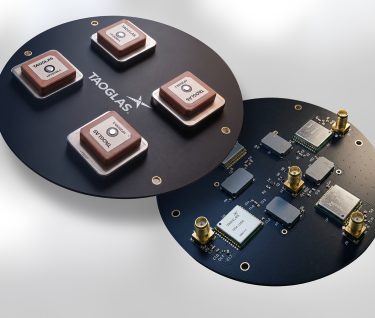
As GNSS jamming and spoofing grow, so does the need for a Controlled Reception Pattern Antenna (CRPA) system to mitigate them. Taoglas’ new reference design meets that need by giving OEMs and systems integrators a convenient platform for evaluating CRPA architectures to get those capabilities to market quickly.
The reference design also is ideal for developing CRPA systems to mitigate environmental sources of interference and attenuation that undermine positioning, navigation, and timing (PNT) data quality and availability. For example, a CRPA system can help suppress low-elevation multipath reflections, which degrade positioning accuracy in urban, semi-urban, and vehicle-based deployments.
All of these challenges highlight why a CRPA system is a valuable addition to nearly any mobile application that requires mission-critical GNSS accuracy and resiliency, including:
- Drones and other types of UAVs
- Delivery robots
- Robotaxis and autonomous trucks
- Precision agriculture equipment such as irrigation systems and autonomous harvesters and planters
- Maritime vessels, including shipping containers
- Highway construction
A CRPA system also helps ensure that fixed applications have reliable access to accurate PNT data, such as for time stamping transactions at:
- Parking garage gates and street meters
- ATMs
- Public EV chargers
- Smart meters and other utility infrastructure
What’s Included
In a CRPA system, adaptive anti-jamming processing sits in a receiver or beamformer. End-to-end null steering requires receiver and processor integration and validation to maximize system effectiveness. The new reference design leverages Taoglas’ expertise in antenna arrays and RF platforms.
Available immediately, the reference design is a four-element, multi-band array with independent RF channels (L1/L2/L5, L1/L2, and L1/L5 variants), developed through architecture, simulation, hardware (110, 150, and 170 mm boards), and validation (chamber, S-parameters,). It pairs with the customer’s receiver or beamformer and provides both the passive antenna and active electronics parts of a complete CRPA system:
- Commercial off-the-shelf (COTS) Taoglas multi-band patch antennas for GPS, Galileo, GLONASS, and BeiDou, including the Accura GVLB258.A for L1/L5 GNSS applications, the HP2258.A for L1/L2 applications, and the HP25258.A for L1/L2/L5 applications.
- Taoglas TFM.110A multi-band GNSS front-end modules and supporting circuitry.
By providing all of the array-level engineering and integration — PCB design, component placement, geometry, and performance optimization — the reference design gives engineers a validated starting point. This also frees them to focus on other aspects of product development, which can help keep projects on time and on budget.
The recommended baseline is the 150 mm 2×2 board, with the 170 mm board as the performance option. The included design files enable engineers to select and integrate the ideal antenna configuration. So instead of a fixed, one-size-fits-all CRPA platform, the reference design provides the kind of flexibility that’s critical for developing products that meet the unique requirements of a specific vertical or customer type.
How to Get Started
The Taoglas CRPA Reference Design provides a flexible foundation for developing and evaluating resilient GNSS systems. Choose the frequency configuration that best matches your requirements and download the complete design package, with reference design files for all three PCB sizes: 110 mm, 150 mm, and 170 mm.
You can download the complete L1/L2 reference design package for all three PCB sizes: 110 mm, 150 mm and 170 mm and explore the specifications and performance of each available PCB size by visiting the dedicated Controlled Reception Pattern Antenna Reference Design webpage here.
You can download the Application Note below.


