
Smartphones such as the iPhone 14 have supported satellite Non-Terrestrial Networks (NTNs) since 2022, and by 2030, nearly half of all brands and models will. That’s impressive — but not nearly as impressive as enterprise IoT.
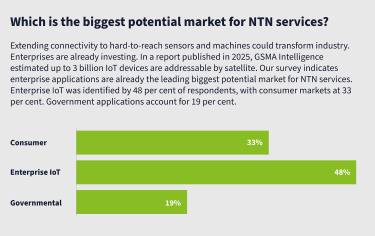
In fact, when it comes to NTN market opportunities, enterprise IoT outranks smartphones and other consumer devices by a wide margin, according to Mobile World Live’s 2026 Satellite & NTN Survey Report.
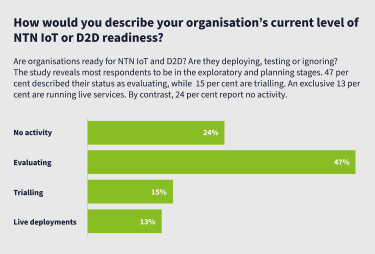
The same survey also found that over half of mobile operators are currently evaluating or trialing NTN for IoT and other applications. For device OEMs developing NTN products, that feedback highlights the importance of understanding and mastering the NTN certification process ASAP. This can provide a competitive advantage by enabling them to respond quickly to operator and enterprise RFIs and RFPs.
But even experienced cellular device OEMs face a steep learning curve. For example, although NTN support debuted in 3GPP Release 17, NTN certification is not a minor extension of terrestrial cellular certification. It introduces satellite-specific conformance tests, new operating bands, timing and Doppler behavior, and OTA questions about gain toward the sky. The certification programs also are still maturing.
A 35,000 km Overview of NTN
NTNs use low Earth (LEO), medium Earth (MEO), and geostationary orbiting (GEO) satellite constellations such as Amazon/Kuiper, OneWeb, Skylo, and SpaceX/Starlink. One consideration is the differences in orbits. GEO satellites sit at about 35,786 km and appear almost stationary, with long fixed delay. A transparent GEO link has a round-trip delay of roughly 0.5 seconds (3GPP studies give about 541 ms). Non-geostationary (LEO) satellites move quickly, so delay and Doppler vary continuously.
NTN uses L-band and S-band spectrum in addition to the terrestrial bands (commonly cited as n255 and n256 in Release 17).
For a deeper dive, see:
- Introduction to Non-Terrestrial Networks, a portal that includes real-world case studies, blog posts, and the portfolio of Taoglas NTN embedded and external antennas.
- “Beyond the Horizon: Designing for Unbreakable Connectivity,” an on-demand webinar featuring Taoglas, Murata, and Skylo.
- The Taoglas portfolio of embedded NTN antennas at https://www.taoglas.com/product-category/embedded-antennas/ntn-satcom-embedded-antennas.
- “The Hidden Role of Antennas in NTN Performance”
Who’s Who in NTN Certification
Two key players in NTN certification are the Global Certification Forum (GCF) and the Mobile Satellite Services Association (MSSA). Their September 2026 Memorandum of Understanding (MoU) covers collaboration on:
- The development of certification requirements and testing frameworks for 3GPP NTN technologies, such as NTN 5G NR, NTN NB-IoT, and D2D services, leveraging the current GCF framework.
- Supporting the deployment of a scalable NTN certification model, promoting interoperability and roaming between terrestrial and NTNs and across different NTN constellations, and encourage validation and field-testing activities in operational conditions by leveraging MSSA operators’ networks.
The relevant 3GPP documents include:
- TS 38.101-5 for NR NTN UE RF requirements
- TS 38.521-5 for NR NTN UE conformance testing
- TS 36.521 for NB-IoT NTN conformance
CTIA’s PTCRB program was established in 1997 to define test specifications and processes to ensure cellular device interoperability. In 2025, this role expanded to NTN with Release 17 test cases.
Some satellite constellation operators have their own certification programs. An example is Skylo, which began working with Keysight Technologies in 2023 on a certification program for Release 17 NTN chipsets, modules, and devices using the narrowband internet of things (NB-IoT) protocol over NTN.
The program initially used Skylo’s test cases but was expanded a year later to include additional ones jointly developed with Keysight. These cover aspects and challenges that are unique to NTN, such as Doppler effects.
Why and How NTN Differs from Terrestrial Cellular
The common denominator for all of these industry and operator programs is that they do not treat NTN simply as a new extension of existing terrestrial cellular certification programs. One example is timing and frequency pre-compensation. Release 17 NTN devices pre-compensate timing and frequency using a GNSS-derived position and time. A certification test must therefore assess the GNSS dependency, as well as the radio.
Some other key differences and considerations are:
- Direction of interest. Terrestrial TRP and TIS average over the full sphere. A satellite link cares about gain toward the sky at the satellite’s elevation angles. Thus hemispherical or elevation-limited metrics and statistical coverage become relevant.
- Polarization. Satellites typically use circular polarization. A handheld with a linearly polarized antenna sees about 3 dB mismatch, and any additional loss comes straight out of the link margin.
- Channel emulation. Tests need delay and Doppler emulation to represent a moving satellite.
- Use cases. Handheld, wearable, and asset-tracker orientations vary, and body effects matter. For example, a wearable’s antenna’s orientation is likely to change as the person or animal moves. A good choice is a ceramic loop antenna — such as the Taoglas NLA.01 — because it supports an omnidirectional radiation pattern.
- GNSS coexistence. The device transmits in the L-band and relies on a GNSS fix. Thus desensitization of the GNSS receiver by the NTN transmitter must be tested.
- Multi-band antenna systems. One device may carry terrestrial cellular, NTN L-band or S-band, and GNSS. Isolation and efficiency across all of them must be verified.
How to Get Started
NTN is a major new technology for device OEMs. That’s why it’s important to be realistic about the learning curve when developing an NTN product roadmap. Assume that the initial products will take significantly longer than expected — especially compared to terrestrial cellular — and set realistic expectations for design, development, testing, and certification. Those expectations directly affect expectations for the devices’ time to market, time to revenue, and market share.
To develop a game plan:
- Choose the NTN type: NB-IoT NTN, NR NTN, or D2D, and the satellite operator(s).
- Confirm which programs apply: GCF, PTCRB, and the satellite operator’s own.
- Plan conformance testing (protocol and RF/RRM), then OTA characterization of the antenna system, and finally field validation.
Taoglas offers a variety of engineering services to help device OEMs develop high-performance NTN products:


